
Your advantage: you’re already on the right track.
The Digital Product Passport (DPP) will fundamentally change how companies exchange product data along the supply chain. As a Teamcenter user, you have a decisive starting position: Siemens has already integrated the technical foundation for this directly into Teamcenter.
Nexpirit helps you put this opportunity to concrete use – tailored to your existing system landscape.
The Digital Product Passport (DPP) is a central element of the EU Ecodesign for Sustainable Products Regulation (ESPR). It requires manufacturers to make structured product data – such as material composition, environmental indicators, and repair and recycling information – available in machine-readable form.
The goal: transparency along the entire value chain, for authorities, customers, and end consumers alike.
But what actually lies behind it? A complex data chain – from the raw material level, through various suppliers and manufacturing, all the way to the finished product. Keeping all this information current is not an IT task to be handled on the side. It is an infrastructure challenge – and it starts long before the QR code.
What the DPP actually requires
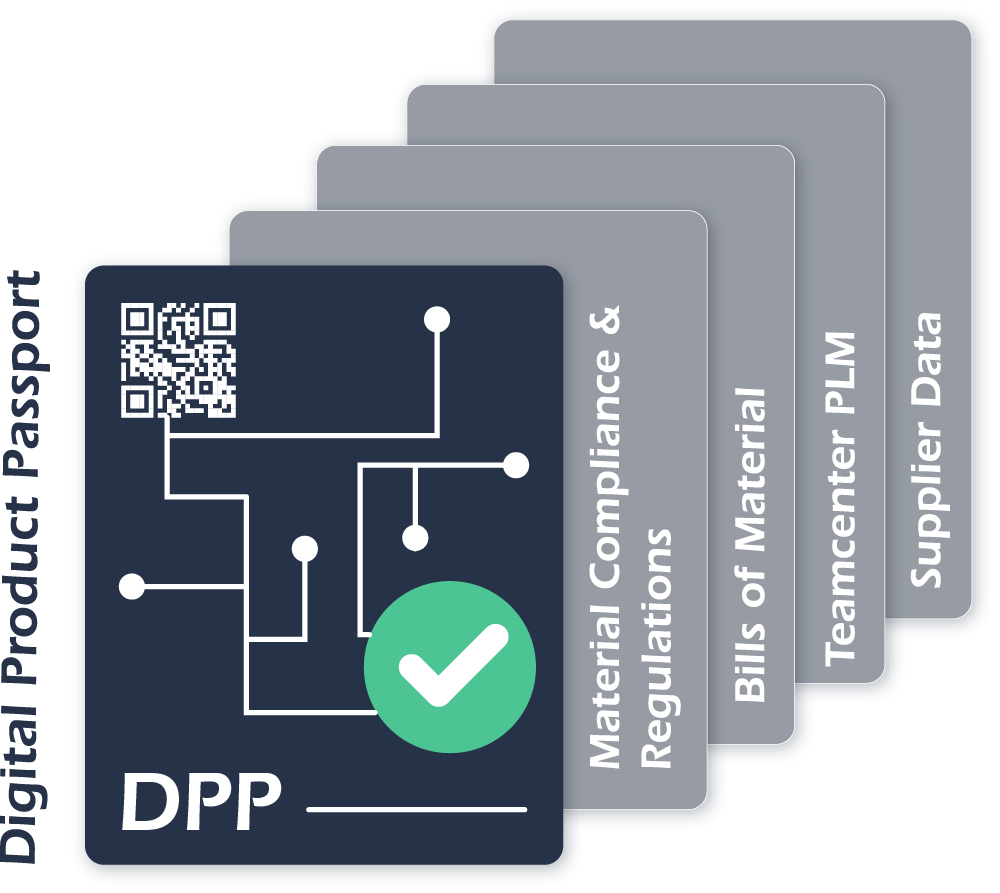
Nexpirit brings exactly the combination that is decisive for the DPP: deep PLM expertise in Teamcenter, long-standing experience in material compliance and materials data management, and the ability to connect data sources along the supply chain via interfaces so that everything flows into Teamcenter in an automated fashion.
The result: a consistent data foundation that not only makes the DPP possible – but maintains it on an ongoing basis.
The ESPR is being introduced in stages. For batteries, the DPP already applies today. Over the next two to five years, the obligation will be extended to further product categories – including mechanical engineering products, electronics, and capital goods. Companies that prepare now will avoid future costs from short-notice system adaptations.
The Asset Administration Shell (AAS) is the open, vendor-independent standard on which the Digital Product Passport is technically built. It defines how product data – from design drawings and Product Carbon Footprints (PCF) to maintenance manuals – is stored in a structured way and exchanged across systems.
What the AAS means in practice

Siemens has natively integrated AAS support into Teamcenter Supplier Connect with the Teamcenter release 2512. This means: anyone using Teamcenter already has the technical foundation for the Digital Product Passport in place.
Siemens Data Exchange Service (DxC)
The DxC makes it possible to search various AAS servers – such as those from suppliers – directly from within Teamcenter. Product data can then be imported directly into your own Teamcenter via the AAS – no manual searching through different data portals, no cumbersome conversion of proprietary data formats.
Evaluations show time savings of up to 79% in data completion, 67% in structuring, and 37% in identifying missing information.
Less manual effort, fewer errors – and a system that is equipped for the regulatory requirements of the coming years.
The Siemens AAS solution in Teamcenter is powerful and complex. Which functions make sense for your organization depends on your industry, your supply chain structure, and your regulatory requirements. Nexpirit guides you in implementing exactly the solution that fits your context.
As with all Nexpirit projects: our Teamcenter solutions are individually adapted to your system landscape. The configuration is tailored to your industry, your supply chain structure, and your system environment.
“What fascinates me about the Asset Administration Shell is that a shared standard suddenly makes possible so much that previously failed due to a lack of interoperability - this applies to data exchange with suppliers just as much as to the implementation of the Digital Product Passport.”
Benedikt Seidel, PLM Consultant & AAS Expert, Nexpirit GmbH

The AAS is still a young standard – but one that is establishing itself. Major industry associations, OEMs, and tier-1 suppliers in automotive, electronics, and mechanical engineering are already relying on it. The more companies adopt the standard, the greater the network effects – and the more suppliers will be expected to support it.
Companies that introduce the AAS today avoid expensive custom integrations tomorrow – and are prepared for ESPR obligations before they apply to their own product category.
Yes – with the right configuration. Siemens has integrated native AAS support into Teamcenter Supplier Connect with Teamcenter release 2512. The AAS is the standardized data format on which the DPP is technically built. This means: anyone using Teamcenter and setting up the AAS functionality can manage the product data required for the DPP – from material composition and Product Carbon Footprint to compliance records – in a structured way within Teamcenter and output it in AAS format.
The decisive factor here is data quality and completeness: Teamcenter provides the infrastructure, but the data must be complete and flow in automatically from the supply chain. This is exactly where Nexpirit comes in – with configuration of the AAS solution, connection of supplier data, and integration into existing compliance processes.
With Teamcenter Supplier Connect (from release 2512), companies can: import and export AAS data directly; manage digital twins for components and assemblies in AAS format; standardize and aggregate supplier data input; structure and exchange Product Carbon Footprint data (PCF) according to the IDTA standard; and keep all relevant asset information – nameplate, documentation, 3D models, change notifications – centrally in one system.
Siemens provides the technical platform and native AAS functionality with Teamcenter. What Siemens does not take over is the individual implementation at the customer site – the configuration to the specific system landscape, the connection to ERP and other systems, the structuring of product data, and the integration of supplier data. This is the task of Nexpirit as a Siemens implementation partner: to set up the AAS solution so that it works in the context of the respective company – and makes the path to the Digital Product Passport concretely achievable.
The Asset Administration Shell – in German also called Verwaltungsschale – is the standardized digital representation of an asset, meaning a machine, a component, a product, or a software component. It defines how all relevant information about this asset – technical data, documentation, environmental metrics, change history – is stored in a structured manner and exchanged across systems. The AAS is recognized as international standard IEC 63278-1 and is further developed by the Industrial Digital Twin Association (IDTA).
The term Asset Administration Shell (AAS) aptly describes the concept: a digital “shell” wraps around a physical or digital asset and holds all relevant information about it – structured, machine-readable, and exchangeable in a standardized way. In the industrial context, the Asset Administration Shell is the foundation for vendor-independent data exchange along the supply chain.
An AAS server is an infrastructure component that hosts Asset Administration Shells and gives other systems access to them – via standardized interfaces (APIs). Companies can operate their own AAS servers and selectively define which data is retrievable for which partners. Alternatively, AAS data can also be provided as a file in .aasx format and imported directly into other systems – a simpler entry point for many companies.
A Digital Twin is the overarching concept: the digital representation of a physical asset with all its properties and condition data. The Asset Administration Shell is the standardized technical implementation of this concept – it defines in which format and according to which rules a Digital Twin is stored and exchanged. In short: the Digital Twin is the idea, the AAS is the standard that makes it interoperable.
A Digital Product Passport (DPP) is a structured, machine-readable dataset containing all essential information about a product throughout its entire lifecycle. Typical components include: material composition and substances, environmental metrics such as the Product Carbon Footprint (PCF), information on repairability and recyclability, compliance records (e.g. REACH, RoHS), unique product identification, and disposal information. The DPP is accessible via a unique identifier – typically a QR code or other machine-readable identifier.
Creating a DPP requires a consistent data foundation – and that is the real challenge. Required are: complete bills of materials down to raw material level, supplier data on substances and environmental metrics, compliance declarations (REACH, SCIP, RoHS), unique product identification, a standardized data format for exchange (e.g. AAS), and the IT infrastructure to automatically consolidate and provide all this data. A PLM system like Teamcenter is the ideal central data hub for this.
The Asset Administration Shell is the technical foundation on which the Digital Product Passport is built. The EU Ecodesign for Sustainable Products Regulation (ESPR) stipulates that DPP data must be standardized, machine-readable, and exchangeable across systems – which is exactly what the AAS delivers. Siemens has chosen the AAS as the technical format for DPP implementation in Teamcenter. Anyone introducing the AAS today simultaneously creates the infrastructure for the DPP.
Talk to us about what the Siemens AAS solution could look like in your Teamcenter environment – and which benefits you can realize today.
Schedule a consultation now.

With our newsletter, you’ll regularly receive insights, event tips, and expert articles directly in your inbox.
*By submitting the form, the data you provide will be processed by Nexpirit GmbH, Lohbach 8, 32457 Porta Westfalica, Germany, for the purpose of processing your enquiry(s). Your data will be processed strictly for the intended purpose. Further information on the processing of your data within our website can be found in our data protection information.